Facebook and Instagram Ads for Local Businesses: A Practical UK Guide
Local Meta ads that bring in enquiries, not just likes
Budgets, radius, creative, lead forms, tracking and honest expectations for UK small businesses running Facebook and Instagram ads in 2026.
Facebook ads for local businesses work best when you treat them as a way to create demand in a tight area, not as a replacement for Google search. For most single-location UK businesses, a sensible starting point is £10 to £30 a day in ad spend, a radius of roughly 5 to 15 miles around where your customers actually live, three to six strong creatives, and either a short qualifying lead form or a fast landing page. Give it three to four weeks before judging it, and judge it on cost per enquiry, not likes.
Below is how we'd set it up for a real local business, including the new UK location fee and the targeting changes most guides haven't caught up with.
In this guide
- Are Facebook and Instagram ads worth it for a local business?
- How much do Facebook ads cost in the UK?
- Targeting your local area properly
- Creative that works for local businesses
- Lead forms vs landing pages
- Meta Pixel, Conversions API and UK consent
- What to expect in the first 90 days
- Launch checklist
- FAQs
Are Facebook and Instagram ads worth it for a local business?
Usually, yes, but for a different job than most owners expect. On Google, people are already searching for you. On Facebook and Instagram, they're scrolling past photos of their mate's dog, so the ad has to earn attention and give a reason to act now.
That makes Meta ads strong where the offer is visual or you can make a clear local offer: cafes, gyms, salons, clinics, home improvement, events, attractions and anything seasonal. It's weaker for "my boiler has just packed in" emergencies, where search wins every time.
| Google Search ads | Facebook and Instagram ads | |
|---|---|---|
| How people find you | They search for what you sell, right now | Your ad appears while they scroll |
| Intent | High | Low to medium: you create the demand |
| Typical cost per click | Often higher in competitive trades | Typically £0.30 to £2.00 in the UK |
| Best for | Urgent, high-intent services | Visual, offer-led or planned purchases |
| Targeting | Keywords plus location | Location plus Meta's AI and your own audiences |
Plenty of local businesses do best running both: Google catches people already looking, Meta builds demand and retargets visitors who didn't call. If you're weighing the bigger channel question, our piece on SEO vs PPC and which delivers better ROI is worth a read too.
How much do Facebook ads cost in the UK?
Meta runs an auction, so there's no fixed price. Your cost depends on your area, your industry, the time of year and, more than anything, how good your ads are. As a guide, UK figures published by Startups.co.uk (updated February 2026) put typical ranges at:
- Cost per 1,000 impressions (CPM): £5 to £15
- Cost per click: £0.30 to £2.00
- Cost per lead: £10 to £40 or more
Treat those as typical ranges, not quotes. A dog groomer in Kendal and a solicitor in Manchester will see very different numbers.
The UK location fee from July 2026
Since 1 July 2026, Meta has added a 2% "location fee" to ads delivered to people in the UK, to cover the UK's Digital Services Tax. It's charged on top of your ad spend, so a £500 month becomes £510 before VAT. Small, but build it in.
Typical monthly budgets for local businesses
| Monthly ad spend | Per day | What it realistically supports |
|---|---|---|
| £150 to £300 | £5 to £10 | One campaign, two or three ads, a tight radius. Fine for a cafe, salon or event push; too thin for proper testing. |
| £300 to £900 | £10 to £30 | One lead or booking campaign plus small retargeting. At a £30 cost per lead, that's roughly 10 to 30 enquiries a month. |
| £900 to £2,500 | £30 to £80 | Prospecting and retargeting, six or more creatives in rotation, two offers tested. Suits trades, clinics and gyms covering several towns. |
| £2,500+ | £80+ | Multiple locations or services, constant creative testing, regular video production. |
On top of ad spend, budget for creative and management. UK pricing guides typically quote £300 to £800 a month for a freelancer and £750 to £2,500 for an agency.
Work your budget out backwards
The best way to set a budget is to start from the customers you need, not from a round number.
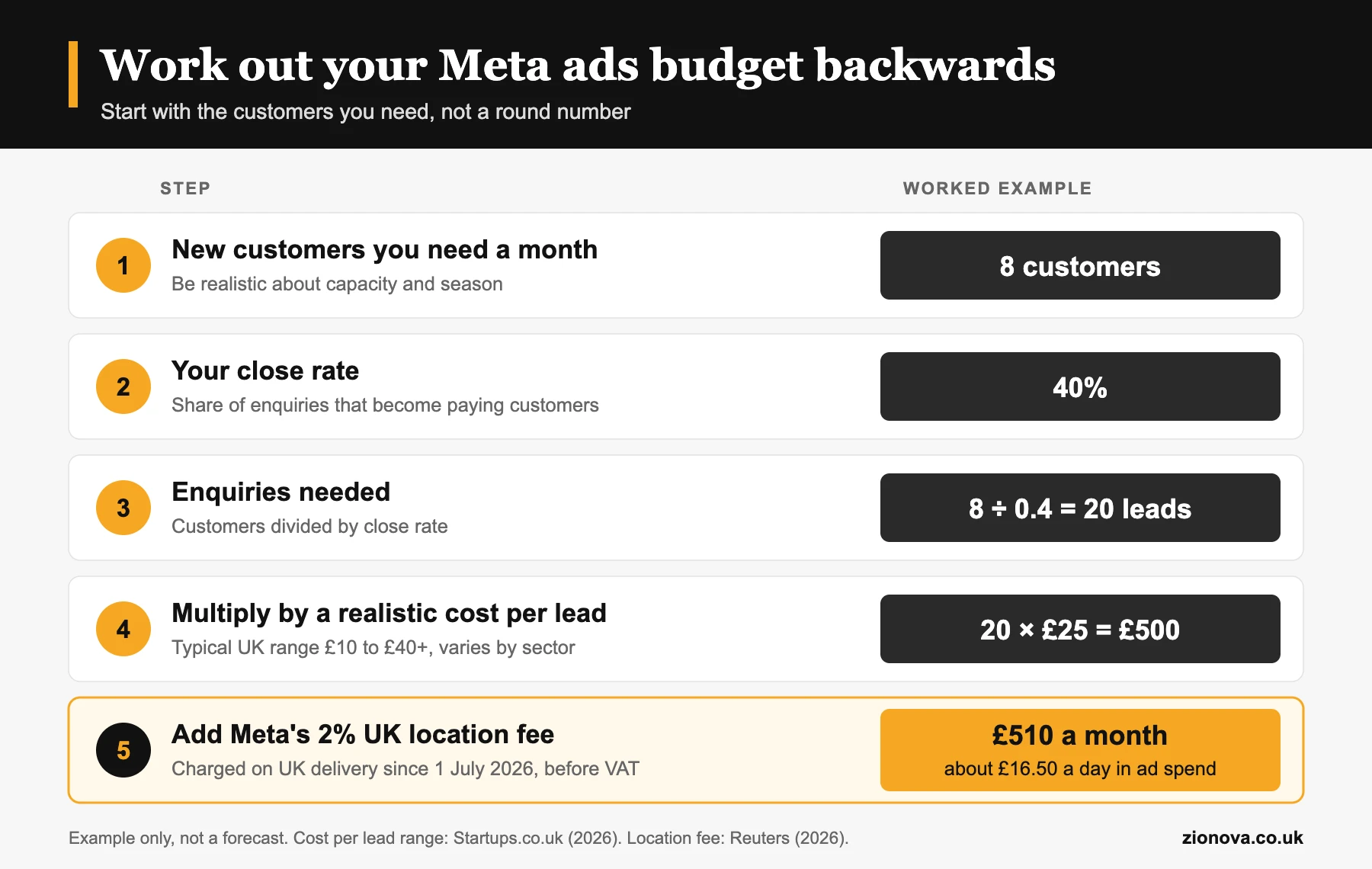
Say you want eight new customers a month and you convert about 40% of enquiries. You need 20 enquiries. If a realistic cost per lead in your sector is £25, that's £500 a month, about £16.50 a day, plus the £10 location fee.
One honest caveat. Meta says an ad set needs around 50 optimisation events in seven days to leave its "learning phase". At £25 a lead, that's £1,250 a week, which most local businesses won't spend. That's fine. Keep the setup simple (one campaign, one ad set, several ads) so all your data goes into one pot, and expect results to wobble more than a big brand's would.
Targeting your local area properly
This is where most local campaigns go wrong, usually by being far too narrow.
Radius limits and what "local" means to Meta
You can drop a pin on your address and target a radius from 1 km (0.63 miles) up to 80 km (50 miles), according to Meta's developer documentation. You can also target postcodes, towns, cities and regions, and exclude areas you don't serve.
The catch: since 2023, the only location option is people "living in or recently in" the area. You can't pick residents only. Meta doesn't define "recently", so a 3 mile radius around a Windermere hotel will include visitors who were there last weekend. For a cafe or attraction that's great. For a plumber, it's wasted spend, which is one more reason not to go ultra-tight.
A location expansion option added in 2024 can also reach people showing interest in a place. Useful for hospitality; switch it off if you only serve residents.
Rules of thumb for radius
- Cafes, takeaways, salons: 2 to 5 miles in towns, wider in rural areas.
- Gyms, clinics, dentists: 5 to 10 miles, or the towns your members come from.
- Trades: your real service area, often 10 to 25 miles.
- Attractions and hospitality: wider, plus the towns and cities your bookings come from.
If your audience is tiny (a few thousand people), Meta struggles to find the responsive ones. In rural Cumbria, covering several towns usually beats a tight circle around one.
Interests, Advantage+ and exclusions
Meta now pushes Advantage+ audience, where your interests and age ranges become suggestions rather than hard limits. With a sensible radius, we usually let it run broad and let the creative do the targeting: an ad about hot tub servicing finds hot tub owners on its own.
Also note that detailed targeting exclusions were removed from ad sets in March 2025, and ad sets still relying on removed options stopped delivering in January 2026. To keep existing customers out, use a custom audience exclusion (a customer list or website purchasers) instead.
Special Ad Categories: estate agents, letting agents, recruiters, mortgage and finance brokers can fall into Meta's housing, employment or financial products and services categories, depending on where the ads run. Where they apply, you can't narrow by age or gender, can't target by postcode, and any location must include at least a 15 mile radius. Declare the category honestly; ads that should have been declared get rejected.
Creative that works for local businesses
With targeting looser than ever, your creative is now your targeting. Meta's ad retrieval system, Andromeda, picks which ads to consider for each person, and Meta's own advice is that a diverse set of creatives helps it deliver more relevant ads. In plain terms: give it genuinely different ads to test, not five versions of the same photo with different headlines.
What tends to work locally:
- Real people and real places. You, your team, your shopfront, the van outside a recognisable street. Stock photos look like ads and get scrolled past.
- Local cues in the first line or first second. "Penrith homeowners", "Five minutes from Keswick centre". People stop for things that are about them.
- One clear offer. A free quote, a first class for £5, a midweek lunch deal, a booking slot this week. Vague brand messages don't drive enquiries.
- Proof. A genuine review screenshot, a before and after, a short walkthrough of a finished job.
- The right shapes. 4:5 for Feed and 9:16 vertical for Stories and Reels, with key text away from the edges.
Aim for three to six distinct ads at launch: a short talking-to-camera video, a before and after, a review-led static and an offer graphic. Refresh the weakest every few weeks. If you don't have the time or kit, our social media content team shoots and edits this sort of thing for local businesses.
And stop relying on the Boost button. Boosting gets a post seen; Ads Manager gives you proper objectives, testing and tracking.
Lead forms vs landing pages
There are two main ways to capture an enquiry: a Meta instant form that opens inside Facebook or Instagram, or sending people to a page on your website. Neither is always better.
| Instant form (lead ad) | Landing page | |
|---|---|---|
| Ease for the user | Very easy, details pre-filled | More effort, they leave the app |
| Cost per lead | Usually lower | Usually higher |
| Lead quality | Mixed, unless you add friction | Usually better, people have read more |
| What you need | A CRM or email alert so leads don't sit unseen | A fast, focused mobile page and tracking |
| Best for | Quotes, callbacks, simple bookings | Higher-value services, online booking, ecommerce |
If you use instant forms, choose the "Higher intent" form type, which adds a review step before submitting. Then add one or two custom questions that a tyre-kicker won't bother answering: postcode, rough timescale, or "what do you need help with?". Conditional logic can send unsuitable answers to a polite closing screen instead of your inbox.
If you use a landing page, build it for the ad, not your homepage: one offer, one form, proof, fast on 4G. A well-built landing page often outperforms a lead form on cost per customer, even when the cost per lead looks worse. For the conversion side, see our guide to turning clicks into customers.
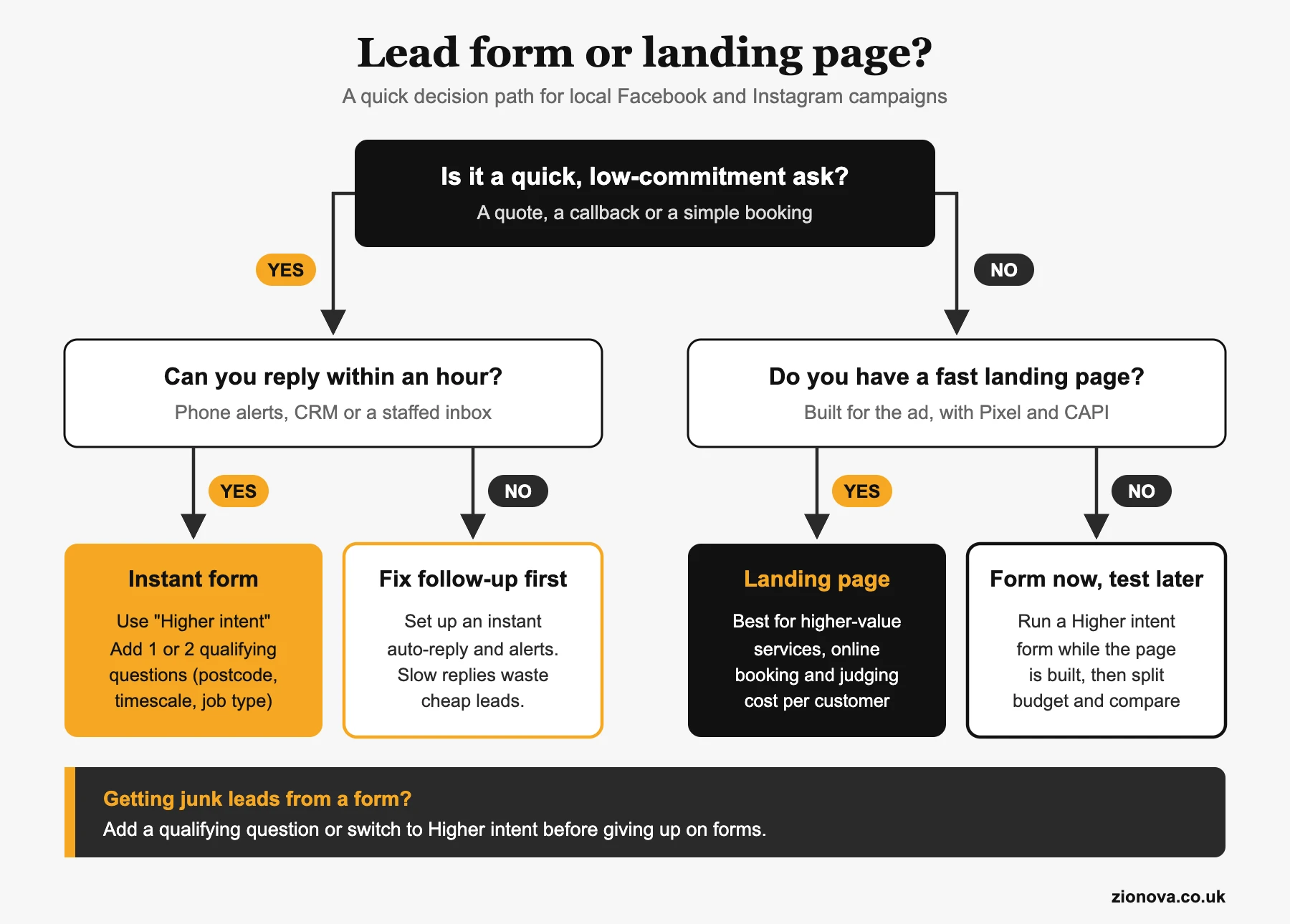
Whichever you pick, speed matters more than the form. A Facebook lead has often forgotten you by the next day, so call within the hour and set up an instant auto-reply. Our email marketing best practices cover the follow-up side.
Meta Pixel, Conversions API and UK consent
If you send people to your website, you need tracking, or Meta can't learn who converts.
- Meta Pixel: code on your website that reports actions (page views, form submits, bookings) from the visitor's browser.
- Conversions API (CAPI): sends the same events from your server or platform directly to Meta. Meta describes it as a way to "decrease cost per result and measure outcomes". It fills the gaps left by ad blockers and browser privacy settings.
Run both, with deduplication so each conversion is counted once. Many website platforms and booking tools have built-in integrations, so it's rarely a big build.
On consent: the ICO's guidance on storage and access technologies (finalised April 2026) covers tracking pixels, and advertising tracking isn't one of the exceptions. Your cookie banner must ask before the Pixel fires. If your tracking is a mess, our GA4 and conversion tracking service sorts out Pixel, CAPI and GA4 in one go.
Retargeting: the cheapest wins
Once tracking is in place, build audiences of website visitors, video viewers and people who engaged with your Instagram or Facebook. A small retargeting budget showing them reviews and a reminder of the offer is often the best-value money in the account. Our remarketing service runs this across Meta and Google together.
What to expect in the first 90 days
- Week 1 to 2: Meta is learning and costs jump about. Leave it alone unless something is clearly broken.
- Week 3 to 4: first real read. Which ads get the cheapest enquiries? Are the leads any good? Pause the clear losers.
- Month 2: new creatives based on the winners, a retargeting campaign, and tighter lead quality questions if needed.
- Month 3: decide on scale. If cost per customer works, raise budget by around 20% at a time rather than doubling overnight.
Measure what matters: cost per lead, then lead-to-customer rate, then cost per customer. Likes, reach and click-through rate are diagnostic, not results.
Launch checklist
- ☐ Page and Instagram connected in Business Manager, with two admins
- ☐ Meta Pixel and Conversions API installed, deduplicated, behind a proper cookie banner
- ☐ Objective matches the goal (Leads or Sales, not Engagement)
- ☐ Radius matches your real service area, with no-go areas excluded
- ☐ Special Ad Category declared if you're in housing, employment or finance
- ☐ Three to six genuinely different creatives in 4:5 and 9:16
- ☐ One clear local offer in every ad
- ☐ Higher intent form with a qualifying question, or a dedicated landing page
- ☐ Leads go straight to your phone or CRM, with an instant auto-reply
- ☐ Existing customers excluded with a custom audience
- ☐ Budget includes the 2% UK location fee
- ☐ A date in the diary, four weeks out, to review cost per customer
If you'd rather hand the whole thing over, that's what our Facebook and Instagram ads service is for.
Facebook and Instagram ads for local businesses: FAQs
How much should a small local business spend on Facebook ads?
For most single-location UK businesses, £10 to £30 a day (roughly £300 to £900 a month) is a sensible test budget. Better still, work it out from the number of enquiries you need multiplied by a realistic cost per lead, then add Meta's 2% UK location fee.
What radius should I use for local Facebook ads?
Match your real catchment, from 2 to 5 miles for a town cafe to your full service area for a trade. Meta allows 1 km to 80 km around a pin. Go wider in rural areas.
Are Facebook lead forms better than a landing page?
Lead forms usually give cheaper leads; landing pages usually give better ones. For quotes and callbacks, start with a Higher intent form and a qualifying question. For higher-value services or online booking, a dedicated landing page often wins on cost per customer.
Should I advertise on Facebook or Instagram?
Usually both. Use automatic placements so Meta can spend where results are cheapest, and supply creatives in 4:5 and 9:16.
How long do Facebook ads take to work?
Clicks start within hours, but give a new campaign three to four weeks before judging it. The first week or two is noisy while Meta learns.
Do I need the Meta Pixel if I use lead forms?
Not strictly, as instant forms are tracked inside Meta. But the Pixel and Conversions API let you retarget website visitors and track bookings, so most businesses benefit from having them.
Want Meta ads that bring in local customers?
We'll look at your area, your offer and your numbers, then tell you honestly whether Facebook and Instagram ads make sense and what a realistic budget looks like.
Talk to ZionovaSources
- Meta for Developers: basic targeting (location radius)
- Meta for Developers: Conversions API
- Reuters (via Yahoo Finance): Meta to charge advertisers a fee to offset Europe's digital taxes
- Startups.co.uk: Facebook ads cost in the UK
- Lilach Bullock: What does running Facebook ads cost in 2026
- Jon Loomer: Meta learning phase
- Jon Loomer: Location targeting changes
- Jon Loomer: Location expansion
- Jon Loomer: Guide to instant forms
- Jon Loomer: Special Ad Categories
- Jon Loomer: Meta Andromeda
- Wicked Reports: Meta removes detailed targeting exclusions
- ICO: Guidance on the use of storage and access technologies