
Digital Marketing for Lake District and Cumbria Tourism and Hospitality Businesses
More direct bookings, fewer empty midweeks
A practical marketing plan for Lake District and Cumbria holiday lets, hotels, B&Bs, attractions and cafes, from Google listings to repeat-guest email.
The best Lake District tourism marketing does three things: it turns OTA guests into direct repeat guests, it makes you visible on Google exactly when people are planning a trip, and it fills the quieter months on purpose rather than by luck. In practice that means a fast website with its own booking engine, a well-kept Google presence (Business Profile, free booking links or Things to do), seasonal paid search, an email list of past guests, and a steady flow of genuine reviews.
Here's how we'd approach it for a Cumbrian hospitality business in 2026, with the costs, the rules and the bits most guides skip.
In this guide
The Cumbria picture in 2026
The numbers explain why marketing matters more than it did a few years ago. Cumbria Tourism's STEAM research for 2024 (published July 2025) found the visitor economy was worth £4.6 billion and supported 74,823 jobs, but visitor numbers were 14% below 2019. Day visits were down 18% on 2019. Staying visitor numbers were up 10% on 2019, yet nights fell 6.3% in a year as trips got shorter.
The Lake District National Park still drew 17.45 million tourists in 2025, so the demand is there. What's changed is the fight for it: shorter stays, more price comparison, more properties chasing the same weekends. Businesses that own their guest relationships and fill shoulder-season midweeks will do better than those relying on summer and the OTAs.
Direct bookings vs OTAs
Airbnb, Booking.com and the big cottage agencies bring you guests you'd never reach alone. They also take a big slice of every booking and keep the guest relationship.
| Channel | Typical cost | Who owns the guest? | Best use |
|---|---|---|---|
| Airbnb | Most hosts now pay a single 15.5% host fee | Airbnb | Reach and filling gaps |
| Booking.com | Commission set per property, commonly around 15%, more with visibility programmes | Booking.com | Hotels, B&Bs, international guests |
| Cottage agencies | Varies by agency and package; ask for the full fee | Shared | Hands-off owners |
| Google free booking links | No cost per click; your booking engine fees apply | You | Hotels and B&Bs with a connected booking engine |
| Your own website | Booking engine, card fees and marketing | You | Repeat guests, direct searches, email traffic |
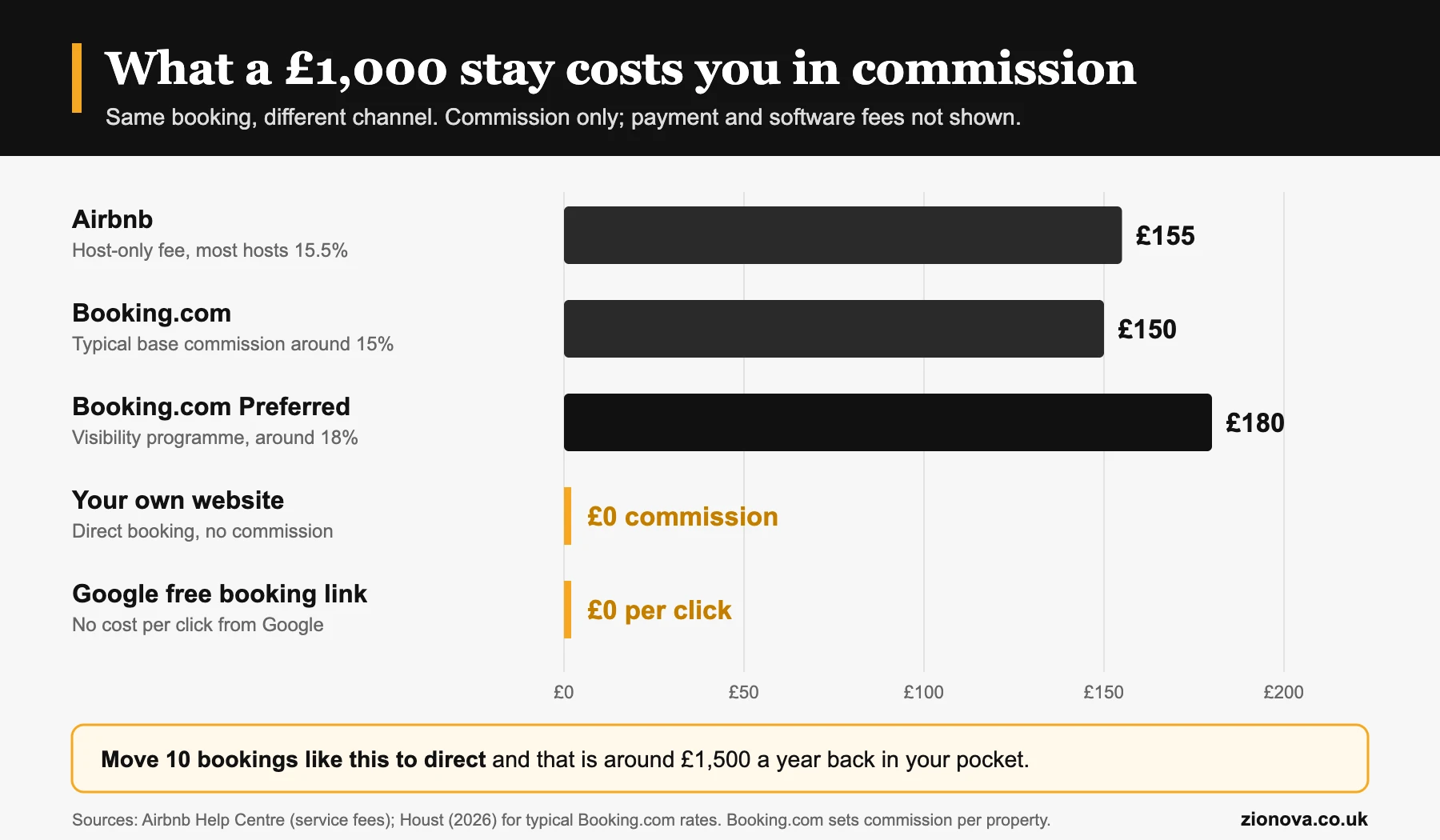
On a £1,000 week, a 15% commission is £150. Move ten of those bookings a year to direct and that's £1,500 back, before you count the repeat stays you can now market to.
The realistic plan isn't to quit the OTAs. It's to use them as your shop window and make every guest who finds you there a direct guest next time:
- Make your property name easy to search, and make sure your website ranks for it.
- Use the stay to collect consent for email, at check-in or in your welcome guide.
- Give a genuine reason to book direct: best flexibility, a returning-guest perk, early access to next year's dates.
- Read your OTA contract before advertising a cheaper public rate on your own site. Rate parity terms can restrict it; member-only offers and added extras are the usual workaround.
None of this works without a website that's quick on a phone and takes bookings without fuss. If yours is slow or sends people to a clunky third-party page, that's the first fix. Our web design team builds sites for exactly this.
Getting found on Google
Most trips start on Google: "dog friendly cottage Keswick", "hotel with parking Ambleside", "things to do in Windermere when it rains". Which Google features you can use depends on what you run.
| Business type | Business Profile? | Booking features on Google |
|---|---|---|
| Hotel, inn, B&B, guest house | Yes, as lodging | Free booking links and hotel ads via Hotel Center or a connected booking engine |
| Single holiday cottage | No: Google lists vacation homes as ineligible | Holiday rentals on Google through an approved connectivity partner |
| Holiday letting agency with an office | Yes, for the staffed office | Holiday rentals via a connectivity partner |
| Attraction, tour, activity | Yes | Ticket and activity links on your profile (Things to do), free or paid |
| Cafe, restaurant, pub | Yes | Menu, photos, reservation links |
Holiday let owners, take note: Google's eligibility guidelines list "rental or for-sale properties such as vacation homes" as ineligible for a Business Profile. Plenty of guides tell cottage owners to create one anyway. It can be removed, or get you suspended. Your route onto Google is your website, OTA listings and holiday rentals on Google through an approved partner (many channel managers are).
Business Profile basics for hotels, B&Bs, attractions and cafes
Pick the most specific primary category, fill every attribute (parking, dogs, accessibility, EV charging), add fresh photos each season and answer every review. Our guide to optimising your Google Business Profile covers it step by step, and our local SEO service can handle it for you.
Free booking links and Things to do
If you run a hotel or B&B, Google's free booking links show your own rate next to the OTAs in hotel search, and Google charges nothing for those clicks. You need Hotel Center access, which most small properties get through their booking engine or channel manager. Ask your provider whether they're a Google integration partner.
Attractions and tour operators can add ticket and activity links straight from their Business Profile, provided they follow Google's Things to do policies. If you sell tickets online, it's an easy win.
Website content that matches how people plan
Generic "luxury accommodation in the Lake District" pages don't rank. Specific, useful pages do: walks from the door, dog-friendly pubs nearby, wet-weather days out, parking and EV charging, getting there by train. They answer real planning questions and give you something to link to from emails and social posts.
Seasonal PPC that pays its way
Paid search works well in hospitality when it's switched on for the right dates and switched off when you're full. A few principles:
- Protect your brand name. OTAs and agencies may bid on property names. A brand campaign is usually cheap and stops them taking your direct bookings.
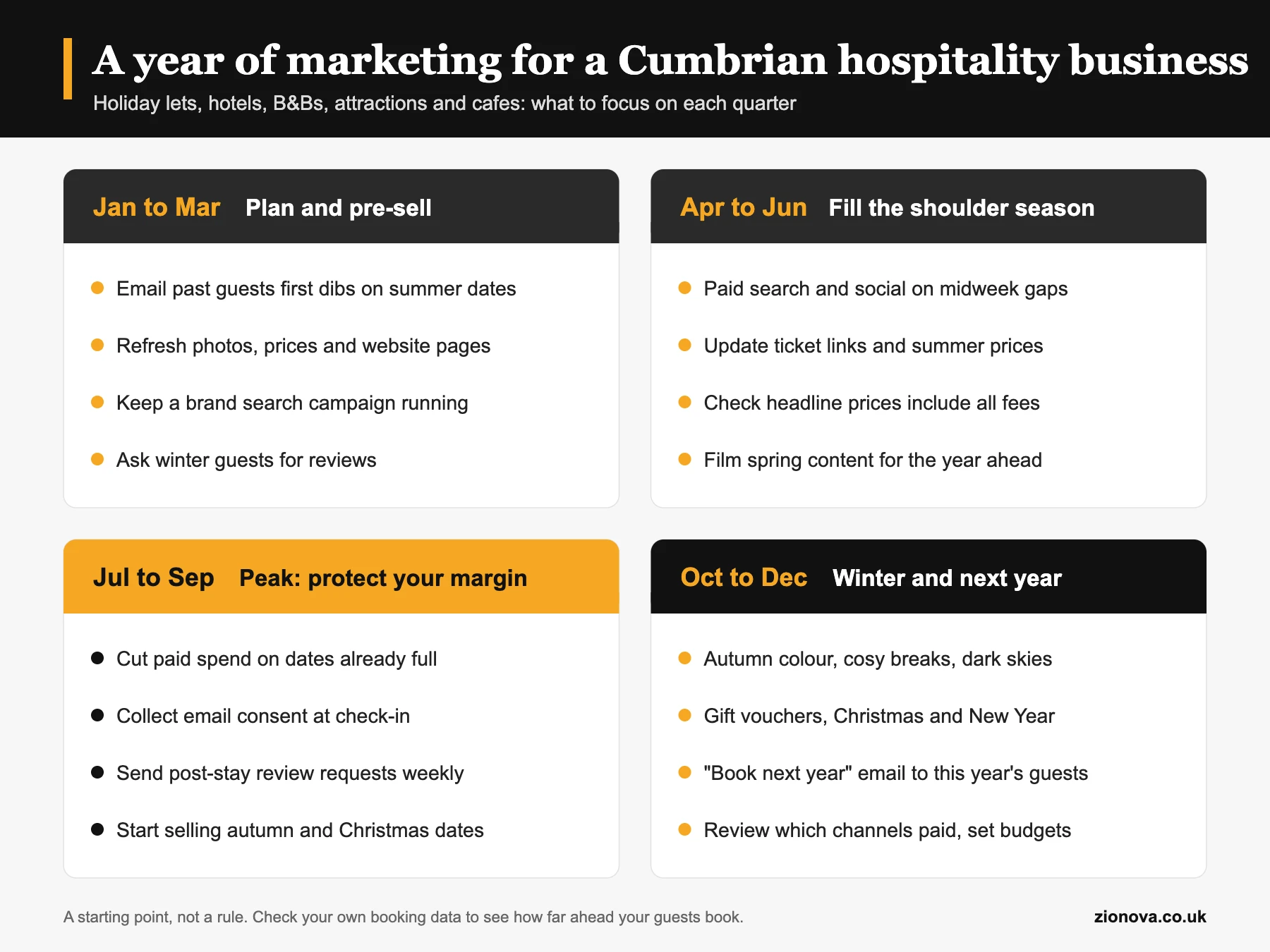
- Spend on availability, not on full weeks. Push the dates you need to fill: shoulder months, midweeks, short notice gaps.
- Target where your guests come from. Your booking data shows which regions send guests. Start there.
- Use the right tools for seasonality. Google says its seasonality adjustments are for short events of 1 to 7 days, not normal seasons, which Smart Bidding already handles. For hotels, Performance Max for travel goals can run ads across Google from your property listing.
Our PPC team can set campaign calendars around your occupancy.
Email and SMS for repeat guests
Your past guests are the cheapest bookings you'll ever get. They know the place, they liked it, and you don't pay commission when they book direct.
The legal side is simpler than people think. Under PECR, the ICO's "soft opt-in" lets you email or text people who bought, or started to book, a similar service from you, as long as you gave them a clear chance to opt out when you collected their details and in every message. Guests who came through an OTA are trickier: you usually don't hold their real email, so collect consent during the stay.
Emails that earn their keep:
- Pre-arrival: directions, parking, check-in, a few local tips. Fewer phone calls, happier guests.
- Post-stay: thanks and a review request a day or two after checkout.
- Anniversary: "This time last year you were in Borrowdale..." with next year's dates.
- Shoulder season offers: sent to past guests before you advertise them anywhere else.
- First dibs: early access to next year's calendar for returning guests.
See our email marketing best practices, or let our email marketing service build the automations for you.
Reviews, pricing and the rules
Reviews
Reviews sell stays. Since April 2025, the Digital Markets, Competition and Consumers Act has made fake reviews, hidden incentivised reviews and suppressing negative reviews unfair commercial practices, with CMA guidance explaining what's allowed. Asking every guest for a review is fine. Offering an incentive is only acceptable if it's disclosed and doesn't depend on a positive review. Only asking guests you think were happy, or hiding the bad ones, is risky. Our guide to building a steady, trustworthy review pipeline shows how.
Advertised prices
The CMA's price transparency guidance says unavoidable charges must be in the headline price. Its own examples include routine cleaning fees, resort fees and booking fees. If your website or ads show "from £120 a night" and a compulsory cleaning fee appears at checkout, fix it. Optional extras such as breakfast or a dog fee can still be shown separately if they're genuinely optional.
Social media that sells stays
Instagram and Facebook are where people daydream about their next trip, so they suit the Lake District well. The content that works is rarely the glossy drone shot. It's the hot tub at dusk, the boot room after a wet walk, the breakfast, the view from the window, the owner recommending a pub.
For paid social, Meta's location expansion setting (added in 2024) can reach people showing interest in a place, not just those who live there, which suits hospitality. Retarget your website visitors with the dates you still need to fill. If you're short on time to film, our social media content team can shoot it on site.
Cumbria Tourism members also get a listing on visitlakedistrict.com and options to feature on its social channels (combined following of 305,000+) and its monthly e-newsletter to more than 78,000 subscribers. Worth weighing alongside your own spend.
Checklist for Lake District and Cumbria hospitality businesses
- ☐ Website loads fast on a phone and takes bookings in a few taps
- ☐ Headline prices include every compulsory fee
- ☐ A clear reason to book direct is shown on the site
- ☐ Google Business Profile complete (if eligible), with seasonal photos
- ☐ Free booking links, holiday rentals or Things to do set up via your provider
- ☐ Brand search campaign protecting your property name
- ☐ Paid campaigns aimed at the dates you need to fill
- ☐ Email consent collected at booking or check-in, with an easy opt-out
- ☐ Pre-arrival, post-stay and anniversary emails automated
- ☐ Every guest asked for a review; every review answered
- ☐ Conversion tracking on your booking engine, so you know which channel pays
Lake District tourism marketing: FAQs
How do I get more direct bookings for my holiday cottage?
Keep the OTAs for reach, but make your website easy to find and book, give returning guests a reason to book direct, and email past guests before anyone else hears about your availability.
Can a holiday let have a Google Business Profile?
Not usually. Google's guidelines list vacation homes as ineligible. A staffed letting agency office can have one. Individual cottages can appear in holiday rentals on Google through an approved connectivity partner.
Should I stop using Airbnb and Booking.com?
Rarely. They're expensive but bring guests you wouldn't reach alone. The aim is to reduce your dependence on them over time.
Can I email past guests without asking first?
If they booked or started booking with you directly and were given a clear chance to opt out, the ICO's soft opt-in usually lets you email them about similar stays. Include an unsubscribe link in every message.
Can I offer a discount for a review?
Only with care. Under the DMCC Act and CMA guidance, incentivised reviews must be disclosed and the incentive can't depend on the review being positive. Most businesses are safer just asking every guest.
What's the best way to fill quiet months in the Lakes?
Email past guests first, then run paid search and social campaigns aimed at your specific empty dates, with an offer or theme such as winter walks, dark skies or midweek breaks.
Run a Lake District hospitality business?
We're based in Cumbria and know how the seasons hit your bookings. Tell us about your property and we'll show you where your next direct bookings are coming from.
Talk to ZionovaSources
- Cumbria Tourism: STEAM research for 2024
- Lake District National Park: Facts and figures
- Airbnb: Service fees
- Booking.com Partner Help: How much commission do I pay?
- Houst: Booking.com fees for hosts
- Google: Business eligibility and ownership guidelines
- Google Hotel Center: About free booking links
- Google Hotel Center: Holiday rental partners
- Google Business Profile: Manage ticket and activity details
- Google Ads: About seasonality adjustments
- Google Ads: Performance Max for travel goals
- ICO: Electronic mail marketing
- CMA: Fake reviews guidance (CMA208)
- CMA: Price transparency guidance (CMA209)
- Cumbria Tourism: Visitor marketing
- Jon Loomer: Meta location expansion